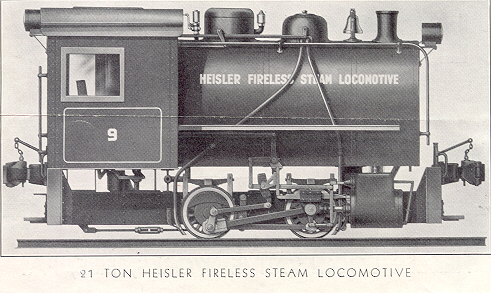
FOUR-WHEEL FIRELESS
The Fireless locomotive is a steam locomotive without boiler or firebox. In place of a boiler the Heisler engine has a tank of welded construction with a capacity of about three times that of an ordinary locomotive boiler. This tank, which is heavily lagged and jacketed to prevent loss of heat, is filled with water to about Four-fifths of capacity. Then, a steam pipe run from a stationary boiler to a point below the level of the water in the tank, the water is heated until the pressure and temperature in, the locomotive tank are the same as in the stationary boiler from which the charge is being taken. It is from this heat stored in the water that the locomotive gets its power. For example, the tank on a 60-ton Fireless locomotive, charged to 200 lbs. pressure, stores sufficient energy to run the locomotive by itself over straight level track, a distance of about 95 miles, or to haul a train of three loaded freight cars weighing 210 tons a distance of 21 milesm or more.
The energy stored in the locomotive tank in the form of heat is transmitted to the rail in the form of tractive force through the expansion of steam in the large low-pressure cylinders of the locomotive. Of course, after charging there is steam in the space above the water in the tank. As this steam is drawn off through the throttle in small quantities and expanded in the low-pressure cylinders as the locomotive works, the pressure and temperature of the steam remaining above the water in the tank are reduced. During this reduction part of the water is turned into more steam, and this process continues until atmospheric pressure is reached and the temperature is 212 degrees Fahrenheit.
The engine can be charged from any stationary boiler which carries a pressure of 100 lbs. or more. One charge may last from two to ten hours under normal conditions of service, depending of course, upon the amount of work required of the locomotive.
The time required for charging a Fireless locomotive depends upon the pressure and horsepower of the boiler from which it is being supplied, as well as the size of the locomotive. With Heisler's improved charging connections and methods, from 10 to 30 minutes for a full charge is the usual time required. Where, the stationary boiler carries superheated steam, charging time is considerably reduced.
There is little danger of the locomotive running out of steam and being unable to return to the point of charging. It will contain sufficient steam for that purpose long after the tank pressure has fallen to a point where no useful work can 6be done, should the emergency ever arise.
The water initially put in the locomotive tank never needs replacing, as the steam condensed in charging continually raises the water level. In fact the engine has to be blown down occasionally to reduce the water to the proper level.
The locomotive is well protected against heat losses. It can be left standing several days without losing sufficient pressure to render it inoperative. Heat losses by radiation while the engine is working are negligible.
Equipped with roller bearings, and as designed and constructed by Heisler, a Fireless locomotive will start and haul a trailing load 5% to 10% greater than can be handled by a conventional engine of the same weight
Only one man is needed to operate the locomotive. When the engine is idle this man can be at work elsewhere, as there is no Fire to keep up or water level to watch. No special training is needed to operate a Fireless locomotive. There is nothing to do but pull the throttle to start and apply the brake to stop.
Depreciation and repair costs are extremely low. The tank is a simple cylindrical drum with elliptical heads; by removing the dome cover it can be completely inspected; there are no staybolts to break, no firebox to burn, no flues to leak, no injectors to maintain, no grates to be renewed; no scale can accumulate because distilled water is used. Boiler repairs are entirely eliminated because there is no boiler.
The locomotive is the only investment necessary. There is no auxiliary equipment. It needs.only a track on which to run, and a connection to an existing stationary boiler plant. The first cost is much less than gasoline, Diesel, gasoline-electric, oil-electric, trolley, storage battery, and such types of locomotives, but just about the same as an ordinary steam locomotive.
Steam is used direct. There are no wasteful transformations of energy. Steam is generated far more economically in stationary boilers than in locomotive boilers. There are no losses worth mentioning in charging the locomotive.
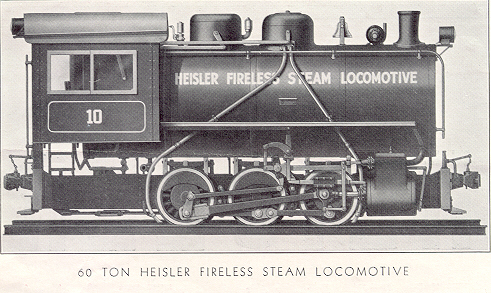
HEISLER FIRELESS STEAM LOCOMOTIVES ARE BUILT IN BOTH FOUR-WHEEL AND SIX-WHEEL TYPES AND IN WEIGHTS FROM SEVEN TO SEVENTY TONS. DETAILED DATA GLADLY FURNISHED UPON REQUEST |
All Heisler Fireless Steam Locomotives are built with tanks electrically welded throughout, the construction conforming to Class 1 of the A. S. M. E. Code for unfired pressure vessels.
Riveted tanks used for Fireless locomotives in the past have been the source of considerable trouble and expense. The rapid introduction into such tanks of high pressure and highly superheated steam now found in many modern plants, causes such rapid expansion of the tank plates as to open up the rivet seams. This is a serious matter, as the tanks need to be heavily lagged and jacketed, making leaks difficult to locate and expensive to repair. Even with low pressure steam a riveted tank has to be very carefully fabricated if laying up of the locomotive due to leaks is to be avoided.
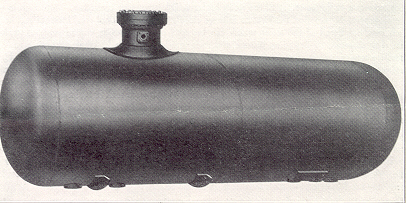
Following usual Heisler policy trouble-proof welded
tanks are used exclusively.
WHILE the Fireless Steam Locomotive is the most simple of all haulage units, it involves problems in design as extensive as the variables of the steam tables which govern its operation. Although in appearance and general construction the Fireless follows closely the conventional fired locomotive, there is hardly an essential detail of the latter which can be used for the Fireless engine without vastly important alterations. For example, in designing pistons and rods, guides, crossheads, crank pins, side rods, etc. for a fired locomotive maximum stresses are definitely fixed by a practically uniform boiler pressure. The Fireless locomotive must not only be designed for maximum efficiency at low pressure including the important item of braking but rods, crank pins and other parts must be protected against contingent stresses which are possible up to the maximum pressure to which the tank can be charged. Auxiliary equipment such as brake cylinders, air compressors, generator for headlights, lubricators, etc., must operate positively and with maximum efficiency with pressures varying over a range of 90%.
The Heisler organization includes engineers and mechanics who have played a large part in the introduction of the Fireless Steam Locomotive in the United States ever since an engine of this type was brought from Europe in 1913. These men have, as well, been largely responsible for the many subsequent improvements and refinements made. Assistance in engineering and design has also been drawn from Europe, where Fireless locomotives were extensively used long before their introduction in this country.
Heisler Fireless locomotives, can be relied upon to the last detail in design, construction and efficiency.
|
|
|
|
"Our Fireless locomotive paid for itself the first fourteen months of operation." - Gas Company.
"Steam for the Fireless locomotive, working 20 hours a day, costs $1.60. For the gasoline locomotive which it replaced fuel cost $7.54 per day." - Lumber Company.
"When We found by experience that we could handle coal with a Fireless locomotive for $.Oll per ton, we purchased a second Fireless for another plant." - Central Power Station.
"Steam for our two Fireless locomotives costs us 56% less than the coal required for our former locomotive; maintenance is reduced." - Tannery.
"By the use of two Fireless locomotives we are saving 65% in the cost of hauling ingots at our open hearth furnaces as com- pared with former methods." - Tube Mill.
"By replacing our coal-buring locomotive with an engine of the Fireless type, we have greatly reduced our fuel and mainte- nance costs. We have used the Fireless locomotive for the past eight years." - Central Power Station.
"We purchased a 45 Ton Fireless locomotive to only move trams into and out of the retorts, but found that it could do al I of our switching without difficulty." - Tie Treating Plant.
"By doing our own switching with a Fireless Steam Locomotive, instead of having it done by the railroad, we are saving $2,760.00 per year." - Machine Tool Manufacturer.
"Absence of fire risk alone recommends the Fireless locomotive. Our three engines of this type are giving excellent satisfaction." - Specialty Manufacturer.
"Our Fireless locomotive is extremely quiet in operation," -Steel Mill.
"Our Fireless Locomotive has been in service nine years and has given satisfactory service as to reliability, general utility, and economy." - Central Power Station.
"Prior to using Fireless locomotwes we used gasoline machines, and our experience has been that we are operating the Fireless locomotive at about half the cost of our old engines." - Tie Treating Plant.
"The locomotive does far more work on one charge than:we 6d expected." - Steel Mill.
"We use the Fireless locomotive 24 hours a day, and have found it very efficient and much more economical than the regular steam locomotive." - Steel Mill.
"Survey of operating cost indicates that the Fireless Steam Locomotive is preferable to any other type." - Steel Mill.
"We are very well pleased with the several Fireless locomotives we have to use.." - Wood Preserving Company.
"The Fireless locomotive is always ready to so without Firing up or continuous stoking," - Central Power Station.
"Abscence of smoke makes the Fireless engine ideal for our work, as the engine enters shop buildings several times a day." - Heavy Equipment Manufacturer.
"Fireless locomotives give the safest means of transportation, which is very essential in our industry." - Explosive Manufacturer.
"Two years of sucessful operation has fully justified our selection of a Fireless Steam Locomotive." - Lock Manufacturer.
"Our Fireless locomotive has been very satisfactory and economical." - Meat Packer.
"With our Fireless locomotive Sunday work cleaning boiler, repairing tubes, grates, etc., is not necessary." - Starch Manufacturer.
"We think it is a very good investment, and know that it will last much longer than a fired locomotive. We are very much satisfied." - Milling Company.
"Results are very satisfactory, efficiency good." - Portland Cement Manufacturer.